

A team of developers can adhere to secure coding standards, keep the dependencies up-to-date, but still ship a vulnerability that nobody notices. Actual attacks do not follow an orderly checklist. An attacker may combine an untrue authorization rule with an exposed API endpoint, evade a password reset workflow, or discover that one customer account has access to the data of a different tenant.
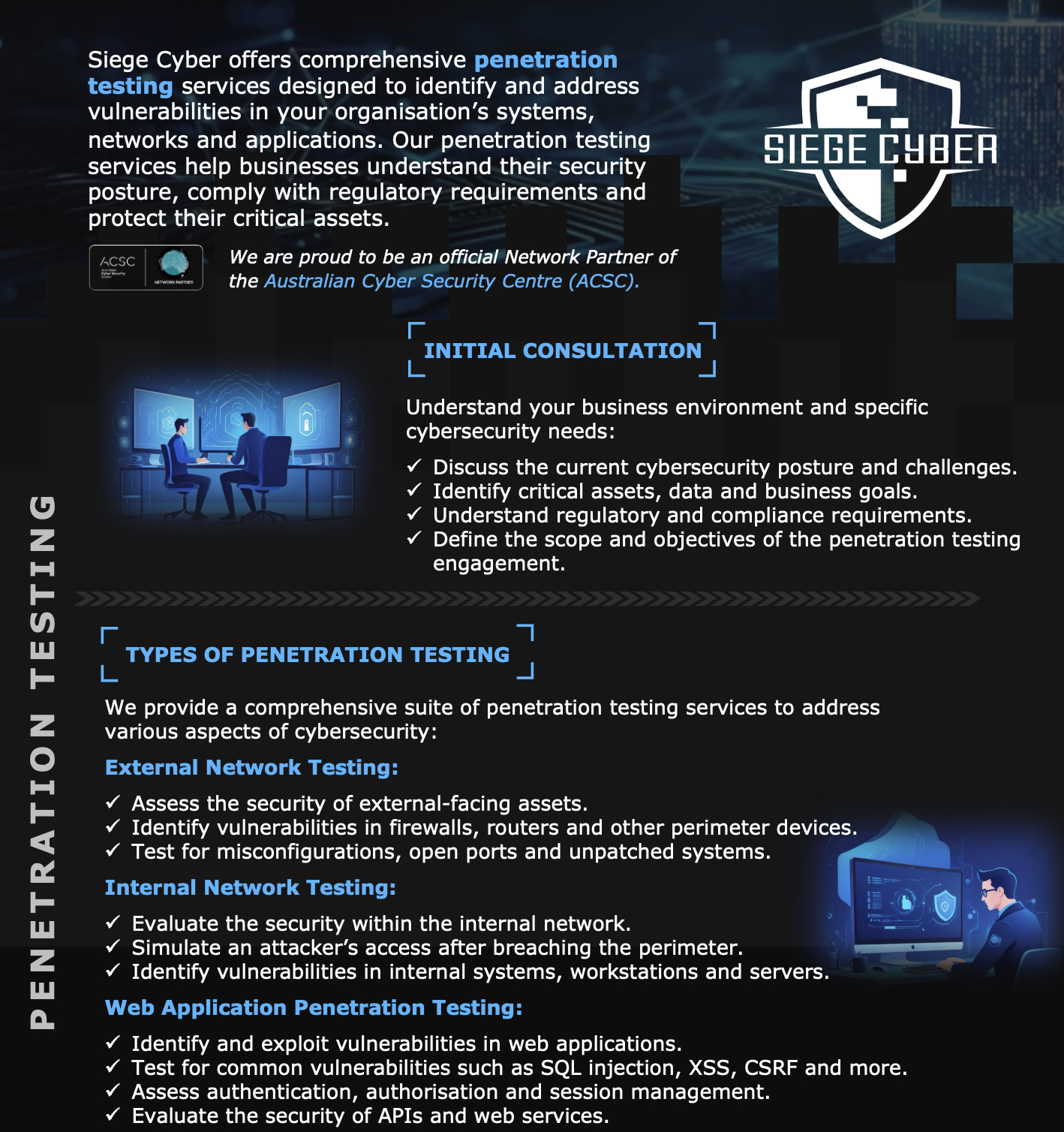
Professional penetration testing Brisbane businesses employ to ensure security assurance looks at the systems from an adversarial point of view. Testers who are experienced don’t inquire if security controls are in place, but if they can be circumvented.
The difference is crucial for Australian companies that handle sensitive assets such as medical records, financial information and customer information, among other sensitive assets.
Scanning by automated means only tells a part of the truth
Vulnerability scanners are helpful. They can quickly spot outdated software, unsecure headers, known CVEs, as well as obvious configuration problems. But, they aren’t able to understand how an application behaves.
Imagine a customer portal which allows customers to alter their account number within an application, and also retrieve invoices from another company. The scanner could not spot something unusual when the server is able to provide perfectly valid results. A human test-taker can identify the error immediately.
Automated web penetration testing combined with manual investigations is the secret to a high-quality test. The testers look for issues in authentication, session, API behavior and configuration, as well as access controls such as injection risk, API behavior.
SaaS environments pose security concerns of their own
Multi-tenant cloud applications need extra attention in testing, since a single mistake can be devastating to multiple users at the same time.
Saas penetration tests should include tenant isolation and privileged features. It should also cover API authorization, changing roles and recovery of accounts, data leakage, and integrations with external services. The tester should not just be able to determine if a feature is functioning however, they must also determine if it can be modified to a degree the developers did not intend.
An individual with a simple role, for example, may not be able to observe administrative functions on the interface. This doesn’t mean the API hinders them from making calls directly. It is vital to try the API out rather than just looking at what appears to be the API.
Modern web applications have a greater attack surface
Applications of today often combine JavaScript front-ends and APIs cloud service providers as well as identity providers and microservices. Any component, or the trust relationship between them, can have weak points.
Thorough web app penetration testing follows those connections. Testers can examine the manner in which tokens and authorizations are handled, whether secure servers enforce the same rules as well as how data moves between different services by users and if a vulnerability which appears to be not a risk could be paired with another vulnerability for a serious security breach.
Siege Cyber specializes in this kind of application testing and is able to work with modern frameworks and APIs, cloud-hosted systems and advanced application architectures rather than treating every website as a list of URLs to be scanned.
This report is a useful tool for developers to identify the solution.
Discovering vulnerabilities is only a small portion of the job. If engineers can replicate an issue, understand the risks involved and confidently rectify it, security testing becomes extremely valuable.
Siege Cyber reports include evidence reproducibility steps Risk ratings, impact analysis, and remediation guidance. Technical teams get the information needed to fix the problem while stakeholders from the business receive an executive level description of the threat. There is the option to escalate critical findings during the engagement, instead of waiting for final reports.
The process of retesting the system following remediation gives an additional layer of assurance to ensure that the initial issue has been fixed without having to design a new one.
Organizations seeking independent verification, proof of compliance or higher confidence prior to release may benefit by conducting penetration tests. It offers a secure setting to observe how an attacker of skill could attack the system. Finding the answer before a real adversary has a chance to do so is what makes the process worthwhile.